
What an engineered septic system costs on a steep Smoky Mountain lot, and why your lot needs one
The short answer first: on a steep or thin-soil lot in Sevier or Blount County, Tennessee, expect an engineered septic system, low-pressure pipe (LPP), subsurface drip, a mound, or an aerobic treatment combination, and expect a total in the reported range of roughly $12,000 to $30,000, versus roughly $3,500 to $8,500 for a conventional gravity system on easy ground. Mounds on shallow-bedrock lots can run past $25,000. No published Sevier or Blount-specific price exists, so every figure here is a labeled national or regional reported range as of July 2026, and the only number that matters for your project is an itemized local bid. This guide explains where the money goes, why the premium is real rather than an upsell, and how to budget without getting surprised.
Why a steep lot cannot use the cheap system
The cost story starts in the rulebook, not the sales pitch. Tennessee's septic rules, TDEC Rule Chapter 0400-48-01, gate conventional gravity drainfields behind three site conditions (sections .07 and .15):
- Slope of 30 percent or less. Between 30 and 50 percent, a special soil investigation is required, and drip designs above 30 percent need a licensed engineer.
- Rock more than four feet below the bottom of the disposal trenches, per TDEC Rule 0400-48-01-.04; confirm exact separation figures with the county, since they are parcel-specific in application.
- Soil absorption faster than 75 minutes per inch.
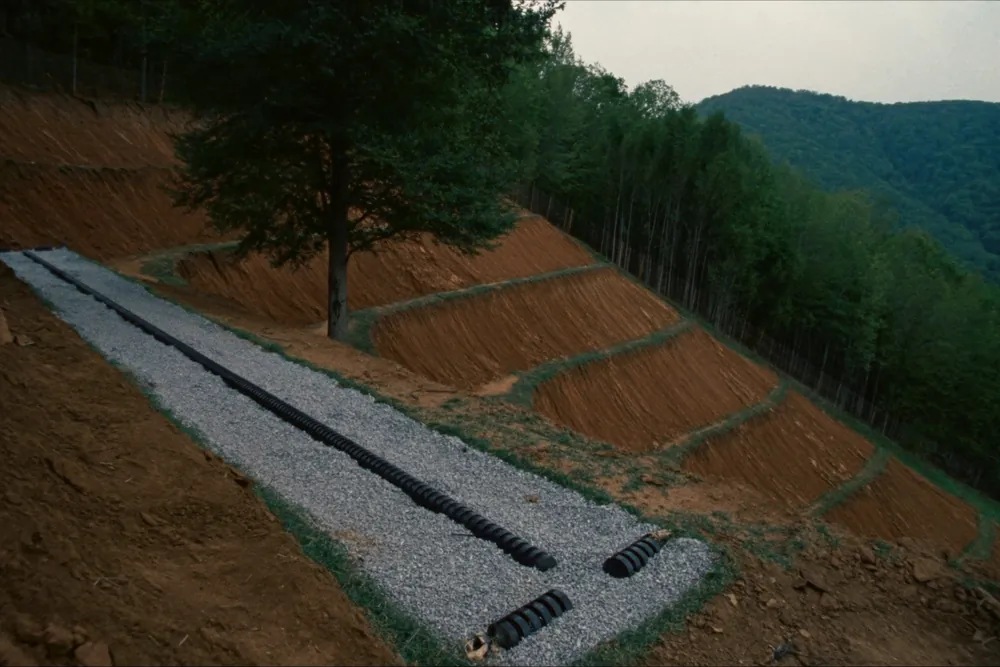
Smoky Mountain foothill lots fail these gates as a matter of geology: the grades are steep, the soil over bedrock is thin, and the rocky subsoil drains slowly. A lot that fails is not condemned; it is redirected to a system that manufactures what the site lacks, pressure dosing instead of gravity, benched contour laterals instead of downhill trenches, imported sand where soil depth is missing, mechanical pretreatment where the soil cannot finish the job. Each of those additions costs money, which is the entire cost difference explained in one sentence. The systems themselves are covered in plain language in the engineered septic systems guide.
The reported cost bands, labeled and sourced
These are national reported ranges from published 2026 cost guides (HomeGuide, SepticTankHub, Angi, ProMatcher), cross-checked against East Tennessee market commentary. They are planning bands, not quotes.
| System | Reported installed range (2026) | Notes for foothill lots |
|---|---|---|
| Conventional gravity | $3,500 to $8,500 | The baseline the gates take away. East Tennessee rock routinely pushes real conventional jobs to $15,000 or more even where permitted. |
| Low-pressure pipe (LPP) | $15,000 to $30,000 with advanced treatment and distribution | The workhorse on steep wooded lots; benched laterals, pump, and controls drive the delta. |
| Subsurface drip | $8,000 to $18,000 | Plus pretreatment where required; engineer-designed above 30 percent slope. |
| Mound | $10,000 to $25,000, with shallow-bedrock outliers reported to $50,000 | Imported sand is the cost engine; hauling it up a mountain driveway is real money. |
| Aerobic treatment unit (ATU) | $10,000 to $20,000 installed | Often paired ahead of drip or LPP on the hardest lots; adds ongoing service cost below. |
| Drainfield replacement (conventional) | $5,000 to $15,000 | Rises to $10,000 to $20,000 or more when the replacement is forced into the engineered lane. |
Add the process costs around the system: a soil and site evaluation at a reported $600 to $2,000 nationally, and county fees, verified for Sevier County at $300 for the construction permit plus $650 engineered plan review (county 2024 fee schedule, retrieved July 18, 2026; Blount County fees are unpublished, call (865) 681-9301). The permit mechanics are in the permit process guide.
Where the premium actually goes
- Pumps, controls, and dosing. Every engineered design moves effluent under pressure on a schedule. Pump tank, pump, floats, control panel, alarm: parts and labor a gravity system never buys.
- Precision earthwork on hard ground. Benching level laterals into a 40 percent grade, or building a sand mound to specification, is slow, surveyed work, often with rock in every bucket. Machine time is the quiet line item that separates a mountain bid from a flatland one.
- Materials the site lacks. Specified sand, gravel, emitter tubing, pretreatment units, all trucked up the same switchbacks as everything else in cabin country.
- Design and review. Engineered plans, the county's $650 review in Sevier, and on steep drip systems a licensed engineer's stamp.
Three planning scenarios, priced honestly
No two parcels price alike, but three composite scenarios show how the bands apply on real terrain. Each uses the labeled reported ranges above; none is a quote.
Scenario one: replacing a spent field under a 1980s chalet
A Gatlinburg-grade lot, original conventional field failing after 40 years, slope past 30 percent, best soil already used. The replacement is evaluated under current rules and lands on benched LPP with a pump tank, at the upper half of the LPP band. Planning posture: reported $15,000 to $30,000 all-in, plus the $300 Sevier permit and $650 plan review, with machine access down a switchback driveway as the wildcard line item. The runway matters more than the number: a declining field usually gives months of warning, so bids can be collected calmly.
Scenario two: a new four-bedroom rental cabin on a ridge lot
A Wears Valley new build where the soil evaluation finds thin soil and moderate slope. Reaching four permitted bedrooms takes drip dispersal behind an ATU. Planning posture: the drip band ($8,000 to $18,000) plus the ATU band ($10,000 to $20,000) rarely sum at their maximums, but the combination sits comfortably in five figures, and the annual ATU service line belongs in the rental's operating budget from day one. The revenue math on the extra bedrooms, covered in the capacity guide, is what justifies the spend.
Scenario three: the karst pasture that looks easy
A flat Townsend cove parcel, no visible slope problem, but the evaluation finds limestone windows close beneath the topsoil. The design answer is manufactured treatment before dispersal, pretreatment with shallow drip, or a mound that builds soil depth above the rock. Planning posture: budget from the mound and pretreatment bands rather than the conventional one, and treat the evaluation fee as the best money on the project, because it is what catches the limestone before the backhoe does.
The ongoing cost honest budgets include
Engineered systems are machinery, and machinery expects service. ATU and pretreatment systems in particular carry an ongoing maintenance and inspection expectation, with service contracts from licensed providers commonly reported at $200 to $400 per year and all-in annual costs of roughly $350 to $800 including pumping reserves. Tennessee's specific contract requirements for your system type are a county question, so confirm them with Environmental Health rather than assuming; the day-to-day reality is covered in owning an engineered septic system.
Why "just do conventional" is not the cheap answer on rock
A tempting misread of the bands: fight for a conventional permit and save $15,000. Two problems. Where a lot genuinely fails the gates, there is no conventional permit to fight for; the county applies the rule, not a preference. And where a lot barely passes, East Tennessee's rock keeps the discount smaller than the table suggests, with regional reporting putting real-world conventional installs on rocky parcels at $15,000 to $20,000 or more once excavation meets bedrock. The honest comparison on marginal ground is often a hard conventional dig versus a designed system that uses the soil the lot actually has, at closer money than the national bands imply.
No, there is no tax credit
Worth stating plainly because the internet implies otherwise: no Tennessee or federal tax credit or rebate applies to a residential septic system or an engineered upgrade. The federal energy-credit lists (26 USC 25C and 25D) do not include septic work, and Tennessee offers no state credit.
Two means-tested home repair programs may be offered to some owners, and neither one is a septic rebate. USDA Rural Development runs Single Family Housing Repair Loans and Grants, also called the Section 504 Home Repair program. The Tennessee Housing Development Agency runs the Emergency Repair Program. You may qualify for one of them depending on age, income, disability, and the repair itself. Amounts and eligibility rules change, so those agency pages are the current answer, not this one. Budget the full price of the job and treat any assistance you are approved for as an offset that shows up later.
How to keep a five-figure project honest
- Get the soil evaluation first. It fixes the system type and bedroom count, which fixes the budget band. Anyone quoting a system before the evaluation is guessing with your money.
- Collect an itemized bid, or two. Line items for earthwork, materials, pump and controls, design, permit fees, and restoration make comparisons possible and change orders rare.
- Verify the credential. Engineered work requires the Alternative class of the TDEC SSDS Installer Permit, verified through the county office in these two contract counties: Sevier (865) 429-1766, Blount (865) 681-9301.
- Plan the timeline calmly. Sevier reports roughly three-week permit processing; Blount operates within a state framework of up to 45 days. A failing field declines over months, so the runway usually exists to do this deliberately.
Reading a bid like a professional
An engineered bid worth signing itemizes at least these lines, and comparing two bids line by line beats comparing totals every time:
- Earthwork and rock allowance, stated as a rate or a contingency, so a boulder does not become a dispute.
- Tankage: septic tank, pump or dosing tank, and pretreatment unit where the design includes one, with brands and capacities named.
- Pump, floats, control panel, and alarm, with the electrical run to the panel assigned to somebody in writing.
- Dispersal materials: laterals, emitter tubing, specified sand or aggregate, and the hauling to get them up the driveway.
- Design, engineering stamp where slope requires one, county permit and plan-review fees, and who files what.
- Restoration: what the disturbed slope looks like when the crew leaves, and who seeds it.
Two bids with the same total can hide very different rock allowances and restoration scopes. The questions to ask before signing anything are the same three the trust module on every service page suggests, starting with the Alternative-class credential.
Getting a real local number
The reported bands above bound the problem, but a steep-lot project prices off the parcel: the slope, the soil map, the driveway, the distance to the dispersal area. That number comes from an independent licensed local septic contractor standing on your ground, Alternative-class credentialed and working Sevier and Blount County terrain. Start on the contact page, with the engineered design and drainfield replacement pages covering what the work itself involves. No fee, no obligation, and the county Environmental Health office remains the authority on what your lot requires.