
Engineered and alternative septic systems for steep Smoky Mountain lots
An engineered septic system is how a steep, thin-soil lot in Sevier or Blount County, Tennessee gets a septic system at all. When a lot fails Tennessee's slope, soil-depth, or absorption tests, state rules move it off a conventional gravity drainfield and onto a designed alternative: low-pressure pipe (LPP), subsurface drip, a mound, or an aerobic treatment unit (ATU). This guide explains each gate and each system in plain language, what the county permit process looks like, and what the engineered lane costs, with every regulatory claim cited to TDEC rule text or a county office you can call.
Why conventional drainfields fail on foothill lots
Tennessee regulates subsurface sewage disposal statewide through TDEC's Division of Water Resources under Rule Chapter 0400-48-01 (T.C.A. 68-221-401 and following). Before a conventional system is approved, the site has to clear three gates, set out in Rule 0400-48-01-.04, -.07 and -.15:
- Slope. Conventional disposal fields are limited to slopes of 30 percent or less. Between 30 and 50 percent, a special soil investigation is required, and subsurface drip on slopes over 30 percent must be designed by a licensed engineer.
- Soil depth over rock. Rock formations must sit more than four feet below the bottom of the disposal field trenches, and conventional trenches themselves run 24 to 48 inches deep. Thin soil over rock also breaks the percolation test setup, which needs 24 inches of undisturbed soil. Confirm the exact separation figures for your parcel with the county; they come from Rule 0400-48-01-.04 and -.07 and the TDEC Soil Handbook (DWR-SSD-G-01).
- Absorption rate. Soil that percolates slower than 75 minutes per inch is unsuitable for a conventional field. Rocky, slowly permeable foothill subsoil frequently lands on the wrong side of that line.
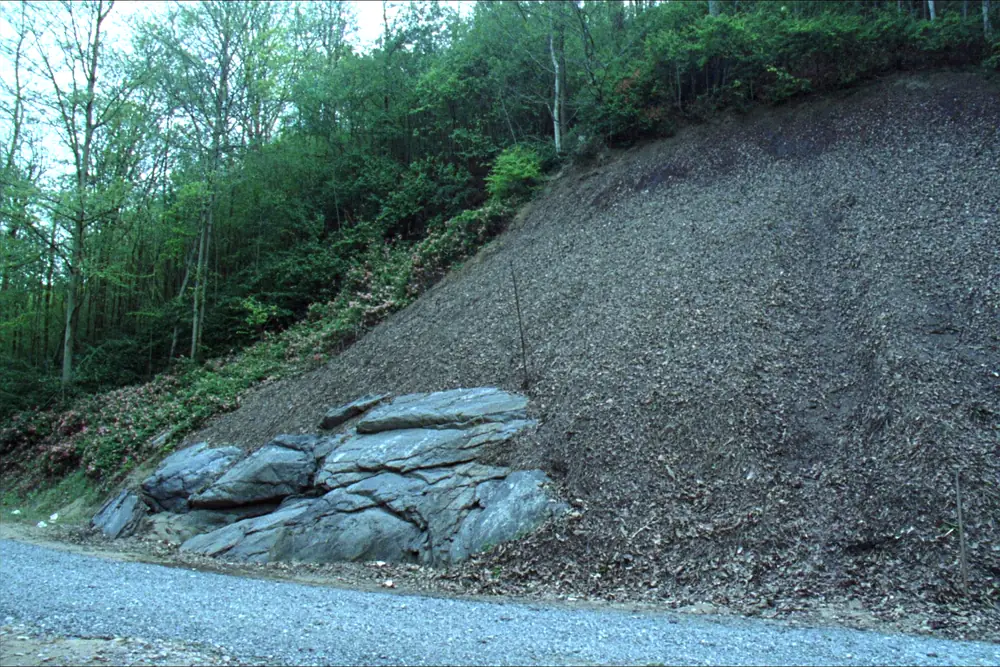
A Smoky Mountain foothill lot can fail all three at once: the grade is steep, the soil over bedrock is thin, and what soil exists drains slowly. On steep grades the problem compounds, because required soil depth is measured where the trench sits lowest, and TDEC's Soil Handbook works examples showing the needed depth growing sharply as slope increases. None of this is a marketing angle. It is the reason engineered systems are ordinary infrastructure in Gatlinburg, Wears Valley, and the Townsend foothills.
The four engineered system types
Low-pressure pipe (LPP)
An LPP system uses a pump tank to dose effluent, on a timer, through small-diameter pressurized laterals laid in shallow, narrow trenches that follow the contour of the slope. Because the laterals sit high in the soil profile, LPP uses the best soil a thin lot has, and dosing rests the field between cycles. On steep lots the laterals are benched level or fitted with gate valves so each run distributes evenly. A modified LPP adds 6 to 10 inches of fill where the natural soil is barely short. LPP is often the least disruptive engineered answer on a wooded mountain lot (Rule 0400-48-01-.15; Texas A and M AgriLife's OSSF program publishes a clear LPP explainer). Getting a quote from a contractor for this work starts at engineered septic system design.
Subsurface drip (SDD)
Drip dispersal pushes filtered, pretreated effluent through emitter tubing buried a few inches deep across the dispersal area, more like irrigation than a drainfield. It tolerates irregular, sloped, or tight dispersal areas well, which suits carved-up cabin lots. The tradeoffs: drip requires pretreatment ahead of the field, adds filters and controls that need service, and on slopes over 30 percent the design must come from a licensed engineer (Rule 0400-48-01-.15).
Mound
A mound system builds the soil the lot lacks: an engineered bed of specified sand placed above natural grade, dosed by pump, treating effluent as it passes down through the sand into the native soil. It is the standard answer where bedrock or a seasonal water table sits too close to the surface, and it is visible landscape architecture, so siting matters on a view lot. Sand-fill depth specifics vary by code edition, so confirm the governing figure with the county before design (EPA's septic system types fact sheets cover mounds well).
Aerobic treatment unit (ATU) and pretreatment
An ATU is a mechanical tank that aerates wastewater, producing effluent clean enough to disperse through a smaller or shallower field, and it is often paired ahead of drip or LPP on the hardest lots. The tradeoff is that it is machinery: it runs on power, and engineered and ATU systems carry an ongoing maintenance and service requirement with periodic inspections. Service contracts with a licensed provider commonly run a few hundred dollars a year; confirm the specific Tennessee obligations for your system with the county, and see owning an engineered septic system for what that looks like in practice.
The four types at a glance
| System | How it solves the site problem | Best fit | Moving parts |
|---|---|---|---|
| LPP | Pressure-doses shallow contour laterals, using the best upper soil | Steep wooded lots with some usable soil | Pump, floats, controls |
| Drip | Meters pretreated effluent through shallow emitters | Irregular or tight dispersal areas; engineer-designed over 30 percent slope | Pump, filters, pretreatment |
| Mound | Imports the sand depth the lot lacks above natural grade | Shallow bedrock or high seasonal water table | Pump, controls |
| ATU | Aerates wastewater to a higher treatment standard before dispersal | The hardest lots, usually paired with drip or LPP | Aerator, pump, alarms, service contract |
Choosing between them is not a shopping decision. The soil evaluation narrows the field, the county reviews the design, and the honest variable left to the owner is usually placement and budget. What matters at the hiring stage is that the contractor has built the specific type on comparable terrain, which is question two in the trust module below.
Who is allowed to build one
Tennessee issues SSDS Installer Permits in two classes, Conventional and Alternative, and the Alternative class explicitly covers LPP, mound, and aerobic treatment work, with drip in the alternative family as well (cleanairtn.org; tn.gov permits). Permits are earned by exam and expire December 31 every year. Because Sevier and Blount administer their own septic programs as TDEC contract counties, the way to verify any installer is a phone call to the county Environmental Health office: Sevier at (865) 429-1766, Blount at (865) 681-9301. Larger engineered jobs can additionally trigger Tennessee's $25,000 contractor-license threshold, a separate regime from the septic permit.
How the county permit process works
Both counties run the same basic sequence, detailed step by step in the Sevier and Blount permit guide:
- Soil and site evaluation. A soil scientist or county environmentalist maps soil depth, slope, and absorption on your parcel. This evaluation, not a sales pitch, determines whether the lot is conventional or engineered and how many bedrooms the system can support.
- Construction permit before any work. Applications route through the county office (state portal: tdec.tn.gov/septic). Sevier's construction permit fee is $300 with roughly three-week processing, and engineered designs add a $650 plan review, per the county's 2024 fee schedule as retrieved July 18, 2026 (seviercountytn.gov; fees change, confirm current numbers with the office). Blount publishes its process at blounttn.gov/299; call (865) 681-9301 for current fees.
- Install by a state-permitted installer, then final approval. The county inspects before the system is covered.
Details specific to each county, office contacts, and what is unique about each terrain live on the Sevier County and Blount County pages.
What the engineered lane costs
Nationally reported ranges, as of July 2026, put a conventional gravity install at roughly $3,500 to $8,500, while engineered systems run roughly $12,000 to $30,000 and beyond: mounds commonly $10,000 to $25,000 with shallow-bedrock outliers higher, drip roughly $8,000 to $18,000, LPP and advanced-treatment combinations $15,000 to $30,000 (HomeGuide and SepticTankHub cost guides, 2026). East Tennessee rocky terrain routinely pushes real conventional jobs above those bands too. No published Sevier or Blount-specific engineered price exists, so treat every number as a labeled reported range and get local bids. The full breakdown, including why the premium exists and the no-tax-credit reality, is in what an engineered septic system costs on a steep lot. One correction worth repeating: no Tennessee or federal tax credit or rebate applies to residential septic work. Two means-tested home repair programs may be offered to some owners, generally elderly, disabled, or low-income households: USDA Rural Development's Single Family Housing Repair Loans and Grants (the Section 504 Home Repair program) and the Tennessee Housing Development Agency's Emergency Repair Program. Eligibility rules and amounts change, so check those agency pages rather than this one, and budget the job on its full price.
Two things engineered-lot owners often get wrong
First, home sales. Tennessee has no statewide requirement that a septic system be inspected when a home sells. Sellers must disclose known septic problems (T.C.A. 66-5-202), and buyers and lenders often want an inspection anyway, but that is due diligence, not a legal mandate. Second, replacement. When an older drainfield on a foothill lot fails, its replacement is evaluated under today's rules, which is how a $6,000 conventional field becomes an engineered project; see drainfield repair and replacement before assuming like-for-like. For new construction, the sequence that avoids expensive surprises is on the new septic installation page, with the permit mechanics under septic permitting and soil evaluation.
Wondering where your own lot stands? Work through does my lot need an engineered system, then let the county evaluation give the official answer. Routine care topics, repair and pumping, have their own pages.
The one-paragraph version
Steep grade, thin soil over bedrock, and slow absorption disqualify conventional gravity drainfields on much of Sevier and Blount County under TDEC Rule 0400-48-01. The engineered systems that replace them, LPP, drip, mound, and ATU combinations, are permitted through the county Environmental Health offices, built by Alternative-class state-permitted installers, and cost a reported $12,000 to $30,000 or more against roughly $3,500 to $8,500 for conventional on easy ground. No state or federal tax credit or rebate applies to residential septic work. The soil evaluation is the first, cheapest, and most decisive step of any project, and the county office is the authority at every step after it.